Card III: The Empress (L’Impératrice)

[Back to Table of Contents]

L'Empress.jpg

Epitome

             The number 3 is equal to 2 + 1, in other words, unity or power of action before a fertile matter, engendering, as a result, fertility.

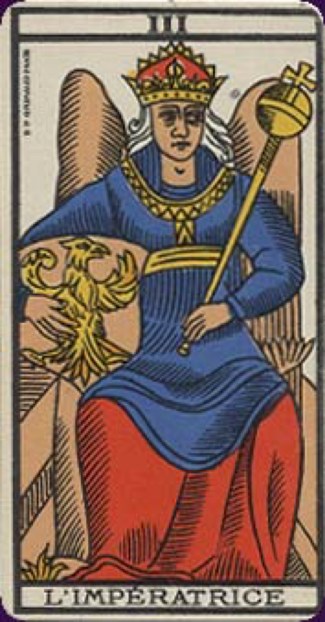
In effect, the card shows a seated woman holding in her right hand the eagle, a symbol of the creative imagination, and in her left hand a scepter, a symbol of creative power, ending in the shape of the terrestrial globe, the manifestation of her power in matter.


General and Abstract Meaning

             This card presents a harmonious assemblage of + and of _, through activity in the passivity of matter, over which she has mastery and, consequently, an organized whole for the purpose of production and evolution, i.e., the EVOLUTIONARY POWER OF FERTILE NATURE.

Specific Analogies

 The golden globe of the sceptre which the Empress holds in her left hand and rests on her arm, represents the universal world, the cross surmounting it indicates that spirituality must dominate over matter by penetrating it.

The shield which she firmly holds in her right arm displays a yellow eagle on a flesh colored background. It signifies intelligence acquired by itself while hovering over matter. On the other hand, its position against the chest indicates that it leans towards the realm of great intuitions, but the eagle, being nothing more than an image on the shield, operates in the imagination rather than reality. As a mobile object, the shield makes it clear that it is able to be willfully abandoned or used to protect itself.

The Empress is seated because she represents the power of the physical world, which is a state of immobile irremovable objects and her invisible feet, as in the preceding card, underscore this. Her enormous throne through its flesh color shows that this is not for her a temporary place to rest, but a definitive steadfastness, because it represents the basis of physical life.

Her crown with three circles of gold on a red foundation describes mortal power. It is open in order to allow the mind to use intuition to penetrate the material world, as indicated by the red color of the cap.

Her golden collar is composed of triangles symbolizing respectively intelligence, matter, and spirituality, signifying through the multiplicity that superior intelligence must be made manifest materially and matter must be made manifest spiritually in all its domains, all of which in the end is One. The collar represents the close interdependence of these three states, which in order to achieve perfection must not and can not be separated.

The belt of gold is the demarcation between the materiality of the lower part, lacking intelligence, and the higher part, dominated by intelligence. The gold pendant has a triangle on it, which by its connection to her collar means that when matter is dominated by intelligence, spirituality ensues, forming a whole.

We find a red robe here as we did on the preceding card: the dominate passions, and above and down to the knees, a blue tunic–that is, the spiritual.

The small tuft of yellow grass indicates passive fertility.

Orientation of the Figure

            The position of the Empress, seated facing the viewer, indicates an action direct which continues in passivity.

Particular and Concrete Sense

             The title of the card, “THE EMPRESS,” signifies the passive power of the material world.

Meanings As They Relate to the Three Planes

             MENTAL. Penetration into the matter through the awareness of practical matters.

ANIMISTIC. Penetration into the spirit of beings. Fertile thought, creativity.

PHYSICAL. Hope, balance. Solutions applied to problems. Improvement and renewel of a situation. The power of irresistible and continuous action.

INVERTED. Disagreements, discussions in the three planes, everything gets tangled and confused.

Delay in the accomplishment of some event, but nevertheless inevitable.

*

            In sum, in its elementary sense, “THE EMPRESS” represents the fertile power of matter made available to Man for his creations.

[Back to Table of Contents]

Card XX: Jugement (Le Jugement)

[Back to Table of Contents]

Judgement.jpg

20 could be obtained by be 10 + 10, expressing on one hand the individual and on the other hand the universal, but taken just as 20, it is neutral and expresses a state without activity, resulting in stability.

The Being, immobilized, looks at the completed cycle, one in the realm of the personal with 1 through 10, and the other one universal with 11 through 20, and makes ready to embark on a new movement forward. He compares his assets and losses, the consequences of his actions, and makes a judgement about himself in order to learn whether the first phase of his evolution is over—that which led him to the World—or if he will obliged to resume his journey with the Fool.

General and Abstract Meaning

            This Card signifies THE INESCAPABLE CALL OF THE DIVINE AND THE SPIRITUAL PLAN IN THE MATERIAL WORLD, REQUIRING AN EXAMINATION AND REVIEW OF WHAT HE HAS GAINED AND WHAT EXPERIENCES HE HAS HAD.

Specific Analogies

            In the symbolic interpretation of the figures and details of this card, the angel represents the divine part which Man, being incarnate in the material world, has left in the divine plane; the angel is represented as a human figure because Man, during his incarnation has need of seeing himself and reflecting on himself in his image. The two wings, flesh colored, show that that which he has abandoned momentarily is able to be brought closer to him, and his arms, being red, indicate that this divine part can be reached and drawn through the deepest matter where it could sink. His yellow hair testifies to the fact that this part of Man is of an intelligence which is in its essence divine, and that he is not able to take it with him into the material world. He is surrounded by blue clouds, because often Man loses every trace of this part of himself, hidden to him, but he has the ability to separate these clouds and to see again his own divinity while elevating himself through spirituality and intelligence.

The trumpet signifies that Man is always able to hear the voice which calls him. It also symbolizes the vibrations which awaken his sleeping consciousness in order to cause him t osee the fruits of his actions and their inevitable repercussions. The rays, by alternating blue and yellow, indicate that the intellectual, divine part of Man, although not incarnated, reflects its incarnation which it cannot ignore in because of the link between the two.  The absence of blue rays comes the fact that the angel, being in the realm of the divine, has no need of spirituality. The pennant, white with a yellow cross, indicates the abstract nature of the divine plan, intangible for us, and impenetrable without the spirit (the yellow) of sacrifice (the cross). This penetration is inevitable because the divine plan is a devouring flame which softens the incarnations of Man towards it, as evidenced by the pennate attached to the trumpet, in other words, the emission of the vibration which wakes Man up and calls him to the divine.

The two figures facing us represent humanity, male and female, and their state of consciousness is symbolized by the third figure whom they contemplate. This one has her back to us, expressing also the fact that this state of consciousness is secret, and she looks at the angel who is known only through the divine. She also represents the state of mind which permits Man to find that which he will forsake when going back to its source, and will make it possible to be incarnated anew. [Translator’s note:  I am puzzled by this. “Elle représente encore l’état de conscience qui permet à l’homme de retrouver celui qu’il laissera en remontant à sa source, et lui rendra possible de s’incarner à nouveau.”]

The posture of the two figures facing us signifies that, in order to know one’s state of consciousness, it is necessary to collect and examine oneself as if in a mirror. The hair of all three figures is blue to show that the material world is only able to evolve when a ray of spirituality has touched it.

These three figures do not refer just to Man, but to the awakening of that which is more material, symbolized by the tomb, in the actions performed on the three planes: physical, spiritual, and mental. They adapt themselves also to everything which lives on the earth, because when the state of consciousness is awakened, everything that is alive approaches its creator.

There are three of them and not a multitude, in order to signify that consciousness is only awakened in an individual’s life and not in collective life.

The tomb is green to indicate that the sepulchre, an image of death, far from being sterile, possesses an enormous power of fertility.

The ground is yellow and the figures are not coming out because it is only slowly, and with the assistance of divine intelligence that Man emerges from the depths of his material being; the difficulties of his journey are symbolized by the rough state of the soil.

This card comes after the Sun to show that Man has taken his origins from the vibrations of the divine force and that he is not able to realize them in harmony, except through a succession of returns to the Earth; although he remains in contact with the heights through the divine part of him, there is nevertheless a suffering part of him which belongs to the incarnation, because, if it is an integral part of God, it is also an integral part of the Material Cosmos.

Position of the Figures

             In the position of the figures, the motionless one, seen from behind, suggest stopping, inaction, while the two others, slightly turned, a woman on the right and a man on the left, sho the contrary orientation of activity and passivity, that which, in this card, makes come to a halt, because they are fixed on the figure seen from behind.

The angel is moving forward, but his action is expressed through his trumpet, to motivate the activity of the lower world towards the spiritual.

Specific and Concrete Meaning

            The name “JUDGEMENT” has been given to this card, not in the sense of justice, but that of comparison and evaluation of the human being through his own mind.

Meanings as They Relate to the Three Planes

            MENTAL. The call of Man to a superior state, his disposition towards and his desires for elevation.

ANIMISTIC. The lack of spiritual radiation.

PHYSICAL. A good card. Library work, compilation, classification. Stability in a good or bad situation. Health and equilibrium.

INVERTED.  Error in one’s own affairs or in general, hardships resulting from an erroneous judgement.

*

            In sum, in its Elementary sense, JUDGEMENT represents Man, awakened from sleep in the material world by his divine part, which obliges him to examine his soul in its nudity and to judge it.

[Back to Table of Contents]

Card XVI: The Tower (La Maison-Dieu)

Back to Table of Contents

LMD 2.jpg

Epitome

            The number 16 can be expressed in the form 10 + 6. 10 represents a completed cycle, but one which is renewed indefinitely, therefore the universal cycle; and 6 symbolizes Involution and Evolution, climbing and descending, construction halted and construction resumed. 10 + 6 = 16 manifests the power of the man who wants to undertake everything, but who, being limited, is not able to attain finality. It is a construction fatally unstable.

General and Abstract Meaning

            The Tower shows THE LIMIT OF HUMAN POWER AND ITS INCAPACITY FOR PERMANENT CONSTRUCTIONS.

The preceding card, the Devil, signified (among other things) evil; but evil, being a figment of human interpretation, has no actual existence, because there are only forces which are striving to progress. The Tower comes after the Devil because it represents human progress, which is always the reconstruction of that which will always be demolished, and that is the same principle as progress.

The Tower signifies, therefore, that everything built by man is destined to be destroyed, whether it is a mental construct or a physical one, because all that is rooted in matter must disappear.

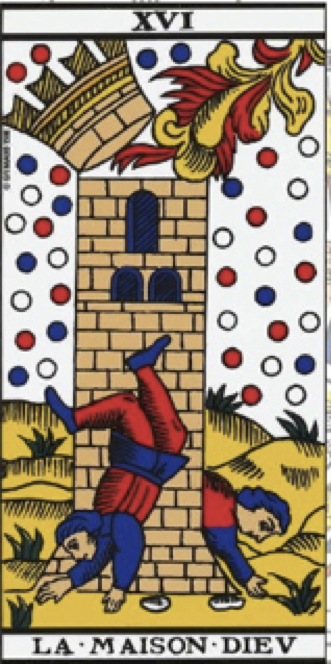
The tower symbolizes a flawed construction, faulty, in which man encloses himself through deliberate obscurity.  It is the color of flesh, since it is built by means of the vital energies of Man on the physical plane.

The windows are blue; the wise man who builds his tower above all maintains his observance of spirituality.

The yellow battlements signify that man constantly desires to crown his work and place on it the seal of Intelligence, but this is an intelligence entirely human and without efficacy. Fire destroys the works of man, but by its yellow color, such as the Sun has, he specifies that they will be purified by their grounding in the earth, by whose contact it draws vital natural energy and is invested with the capacity for beginning again.

Besides, fire is the force which Man is always able to avail himself of in the divine in order to continue his task which, however, he never achieves. It also represents the purifying fire which man will pass through when he forsakes his ephemeral edifices in order to proceed into the divine plane. The flame, with its red coloring, also indicates its activity in the material world and, by its yellow color, its divine intelligence.

The blue and red man, touching the ground with his hands as he falls, shows that whatever it was that caused him to fall–material or spiritual–he avails himself of the flowing forces of the earth as he presses his hands on the ground in order to begin his task anew. With his semi-circular pose, reminiscent of the action of the outstretched hand with which one performs an action in the outer world, the active pole is symbolized. It thereby characterizes the man who has functioned in such an environment, who has played and lost his constructive combination.

The second figure, whose fall has the opposite meaning of the first one and who is what looks to be a horizontal position symbolizes the second pole, the passive pole, and so likewise he is falling harder, because Man becomes, through inertia, incapable of mastering the forces which he has seized, loses their support he was depending on, and falls down in the material world.

His fall is not the direct result of his actions, but a slow descent produced by remote causes.

The balls are the seeds of this construction falling to the ground to be germinated anew; the red and blue signify that the reconstruction will be material and spiritual. The white ones represent the apparent futility of effort. None are yellow, because Divine Intelligence does not preside over this Card, which refers exclusively to human works. The balls represent, by their number, the multiple ways which Man is able to build constructions on the physical plane; they are the contributions of men coming from different backgrounds.

The ground, yellow with tufts of green grass, indicates that the sun, made fertile through the work of man, bears fruit.

Orientation of the Figures

            The position [of the tower] is head-on, indicating a direct, violent action.

Specific and Concrete Meaning

            The name of this Card, “LA MAISON-DIEU,” comes from that which God, being omnipresent, is even in the building which Man is building, but, as He does not intervene and, as Man is in the dark, his constructions are imperfect and doomed to destruction. Born from the mind of Man who believes them to be soundly built, they are devoured by the same flame of his desire and, therefore, bring about their fall. The tower, built of dense material, is too concrete to give access to the subtlety of the spiritual current represented by the lighting bolt; it disintegrates. The tower also signifies that Man, believing himself to be so powerful, raises himself up to extend his domination, but as his free will is so limited, he sees it fall apart while believing it definitive, and then begins anew. It also symbolizes man trapped in his own ideas and construction of theories which vanish in the face of experience.

Meanings as They Relate to the Three Planes

            MENTAL. An indication of the danger of continuing on a certain path, with a fixed idea, and a warning to avoid the consequences on pain of collision and annihilation.

ANIMISTIC. Domination of other beings with neither charity nor love, exercised over others with despotism, and which, sooner or later, will be rejected out of affection.

PHYSICAL. Project abruptly stopped. Dramatic turn of events, unexpected shock. Warning to be on one’s guard in business. The flame uncrowning the tour can be interpreted as being freed from prison.

With respect to matters of health, an indication that one has exceeded the limits of his vital owers and that he is in risk of a serious affliction. As a consequence of some sickness, recovery after a painful condition.

INVERTED.  Great cataclysm, utter confusion.

*

            In sum, in its Fundamental Sense, “THE TOWER” represents constructions of men which are ephemeral and fertile, always destroyed, always resumed, painful because they ruin ambitions, beneficial because they constantly increase the riches of wisdom.

[Back to Table of Contents]

Card II: The Female Pope (La Papesse)

Back to Table of Contents

db_GRI-_II_-_La_Papesse1.jpg

Epitome

            The number 2 is equal to 1 + 1. Unity, being the origin of the numbers, can engender through successive additions a series on the increase which, consequently, is positive. It can also engender a decreasing series which is negative.

If the two units represent a single direction, there is a collision and halting of the movement. If they are contrary directions, there is a polarity, the birth of a movement and the establishment of some fertile entity.

The number 2, a synthesis of these two points of view, that of halting and of another movement, symbolizes a nature which can be fertilized, which is generally defined as a halting and a plasticity.

General and Abstract Meaning

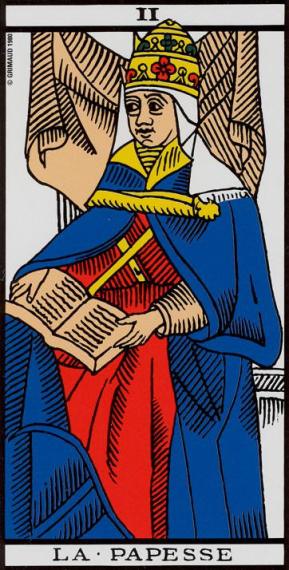
            The figure on Card II consists of the large image of a woman covered with veils, wearing a tiara [sic] and corresponding therefore to a fertile nature universal and sanctified, that is, carrying within her, in a latant state, the cosmic power of production. She can be regarded as THE DIVINE SPOUSE, THROUGH HER CAPACITIES OF ETERNAL ENGENDERING  AND CREATING THE ILLUSORY REALITIES OF THE Maya [Sanskrit].

Through her passivity in the spiritual world, she represents mystery, things hidden, she contains within her the riches which she unconsciously bears because they are not externalized. The open book on her knees indicates that it must be decoded, perceived, rather than read, since, the image depicts her placing a finger on the book without reading it, like a blind man who feels his way: it is the representation of the infinite possibility of nature.

This card, thus, represents the occult, intuition, the comprehension of the powers of nature. She is passive before the Juggler, but he can do nothing without her, because the active principle would get lost in the Infinite unless it met the passive principle that restrains it, covers it, and gives shape to what it wants to create.

Specific Analogues

            The significance of the colors of the clothing are similar to those of Card I. The red robe indicates the dominate passions; the blue mantle, spirituality realized in itself, effacing the passions, as well as the religion and mysticism which recovers and protects it. The collar of the mantle, its closure and the yellow cords are the lines which retain wisdom; bringing spirituality, and subordinating passions to the intelligence.

The Female Pope wears a tiara of gold to show that she is illuminated by solar rays, that is to say, by higher wisdom; its three levels, encrusted with precious stones, evoke the three worlds: the physical, the spiritual, and the mental.

The physical circle, the lowest of the three, has a band with alternating rubies and topazes. The rubies, arranged as four-leaf clovers, represent the activity of earthly matter. The topazes, a symbol of the awareness of universal laws, alternate with the rubies, but they are smaller and signify that the earth is very faintly lit by wisdom.

The spiritual circle which is placed in the middle bears emeralds. These indicate consciousness in the physical domain, and the two pearls which frame them represent the sublimation of feelings, physical suffering which leads one towards spiritual happiness.

The third circle, which contains only a round crystalline stone, cut like a diamond, symbolizes pure mind and with its round shape indicates that its role is infinite, that is, with neither beginning nor end.

Under the tiara we see a white veil spilling down onto the figure’s shoulders: The Female Pope can and and should be a symbol of purity.

The flesh-colored drapery behind the tiara, shows that the higher part of the woman, a symbol of passivity, can be hidden by the veil of matter. It floats around tiara to communicate all the instability and mobility of the feminine principle before the rigidity of wisdom indicated by the tiara, whose character is of an immutable and eternal being.

The opposition between the white veil and the darker drapery expresses the fact that the feminine principle attracts sexual instincts out of its need of maternity, while its unconscious intentions are pure.

The drapery can equally be interpreted as an aspect of wisdom, but as it is loose and can be removed and put back, it can only represent a purely earthly wisdom.

The open book is flesh-colored to show that it represents the evolution of life on the physical plain, not only in all its modalities, but also as heredity and as a continuance of the species.

The tiara and the book have very different interpretations. The open book shows that the woman, taken as a representation of the feminine principle, bears within her the awareness of nature, but she can be a victim, when she lets herself be masked by the veil of flesh, a symbol of the passions which imprison and enslave her. But she is also able to have the perception of pure nature, if she preserves the purity of the white veil. She is able therefore to read the book which reveals to her knowledge of the past, the laws of nature, of manipulation of these laws, while the tiara brings her knowledge from Above, indicated by the glittering of the precious stones.

Her feet are invisible because she must remain immobile, owing to her passivity.

Orientation of the Figure

             The position of the Female Pope, seated, turned three-quarters to the eft, signifies work, the activity of concentration, calm, and meditation.

Specific and Concrete Meaning

             The title of the card “THE FEMALE POPE” signifies the higher principle of nature, that is, of matter sanctified.

Meanings as They Relate to the Three Planes

            MENTAL. This card is replete with ideas. It solves problems but does not raise any.

        ANIMISTIC. She is cold, she is warm, welcoming, but she is not emotional.

        PHYSICAL. The situation is certain, necessitated through events, the revelation of hidden things, assurance of triumph over evil. Good health, weightiness.

        INVERTED. She is weighed down, becomes more passive; one can drawn upon her no more;  she is a burden. The intuitions which she was bringing forth overturn their meaning and become false. Delay, halting, burdensome to realize.

*

In sum, in its Elementary Sense, “THE FEMALE POPE” represents Nature, with its mysterious riches, which Man must unveil and interpret.

Back to Table of Contents


Card XVII The Star (L’Étoile)

Back to Table of Contents

        TheStar

Epitome

          The number 17 = 10 + 7.  10 represents the universal cycle, and 7 the septenary–that is to say, the expansive diffusion expressed by the universal spectrum and specified by the 7 sounds, the 7 colors, and so forth.

The number of small stars in this Card also evokes 7 = 3 + 3 + 1, that is, the ternaries of the Seal of Solomon, to which unity adds the principle of activity. The set is synthesized by the large central star symbolizing the emanation of Divine power which sends into the material world the forces of involution and evolution.

General and Abstract Meaning

         This Card, supported by the psychic and the spiritual, represents the PRINCIPLES WHICH PRESIDE OVER THE HARMONY OF THE WORLDS.

It puts the beauty of Divine construction in opposition with the imperfection of human construction, always being renewed.

It places at the top of the sky, the stars, the active principle of cosmic edification, the sources of light, and below, in the material world, a woman, the source of physical life.

It comes after The Tower in order to represent harmony, the great universal forgiveness, the balm which always comes after a fall, the soothing of people for their recovery.

The stars represent the worlds on the psychic plane.

The great central star, arranging the seven secondary stars around it, synthesizes the seven notes of the universal spectrum in order to make it one single harmony, this is underscored by its eight yellow rays, as eight constitutes an octave, that is, a complete series. The eight red rays interposed form the same principle in the material world, because, for human necessity and understanding, it requires that the principles of divine intelligence are repeated in the material world. The whole unity forms the number 16, taken as 8 + 8, which, by its repetition in the two poles, symbolizes the perfect bond between the material and spiritual worlds.

Under the stars and above the ground appear two trees whose green color is the image of renewal; on one of them is perched a bird, symbol of individual life able to attach itself to the ground or to hover in space, ever singing the morning wakeup song, the joy of renewal.

The female figure is nude, showing thereby that the principle of harmony does not require any substance and is not active in one plane more than another. The woman has one knee on the ground, indicating that harmony is not immobilized in one place, but it must always be ready to take a step forward.

She is the great feminine principle which directs the current of the worlds and the struggle of their evolution. She causes this current to emanate from two vases, representing condensations permitting one to measure out, at times, a spiritual influx whose intensity is such that it cannot be effective unless it is channeled. She is handling them so as to pour out a dosage that people can handle.

The horizontal vase held in her left hand indicates a passive contribution, given to Man in his repose, as if by chance.—such as the one who receives wealth while asleep—while the vertical vase represents the active contribution, which is to say, that which Man obtains through his work.

The woman is on the extreme edge of the ground, because she is the source from which the water flows. This water is tinted blue to signify that this source, of a spiritual order, never dries up, but can only operate through its dependency on the substratum of a Divine intelligence.  This is expressed by her knee being placed on the ground whose yellow color and chaotic, rough appearance permits her the chance to shape and fashion it into something beautiful.

She holds two red vases in her hands, thus showing that it is by means of the material world that one must draw, from the river of spirituality, evolutionary harmony.

Furthermore, these two vases represent the two poles of fertility in matter. The vase of passivity is closer to her, as the female in the processes of fertility is playing a role superior to that of the male, and she is better suited to be a model of universal beauty.  This vase is touching her genitals and its short flow strikes the sand, indicating that it is a physical receptacle connecting the instinctive vital current of an individual with the material world (the ground) realized by the Divine intelligence.

The active vase held in her right hand touches her knee and the flow of the liquid which it contains leads to her right foot. It is, therefore, a physical action producing an expansion in the spiritual and sensory plane, represented by the flowing blue water.

In sum, these vases and the water they contain represent the great cosmic current which never ceases to flow, ever fertile and renewing itself.

Orientation of the Figure

         The position of the woman, turned three-quarters to the left, shows by this a reflective disposition moving towards realization, a state of passivity becoming active.

Particular and Concrete Meaning

         The name “THE STAR” has been given to it to represent an illuminating and redeeming power, symbolized by the stars, as they bring forth clarity from the Infinite.

Meanings as They Relate to the Three Planes

         MENTAL.  Some form of assistance that offers a power which can be made use of, but not right away, since we must know how to use it. It is inspiration about what must be done.

ANIMISTIC.  The Star gives off currents of stability and radiance.

PHYSICAL.  Satisfaction, the love of humanity in all its beauty; the fate of the sentiments which animate a being. The realization of things in order and harmony. In a question about art, it suggests the idea of charm–that is to say, the radiance which attracts others.

         INVERTED.  Harmony disrupted in its destiny, physical harmony without duration.

*

         In sum, in its Elementary Sense, “L’ETOILE” represents the celestial illumination which causes man to witness the dawn of peace, of hope, and of beauty, things which support him in his struggles, providing him with the comfort in the midst of his failures and guiding him through his vicissitudes, and never failing hm in his participation in cosmic harmonies

Back to Table of Contents


Card XVIII: The Moon (La Lune)

(Rough draft of a translation of Paul Marteau’s Le Tarot de Marseille)

Back to Table of Contents

TheMoon

Epitome

         As the Tarot, owing to its evolutionary principle, has been conceived in accordance with analogies which derive from the number 10[1],  the significance of Card XVIII must be derived from the combination 10 + 8.  10 essentially implies the repose which follows a completed cycle; and 8, because of its indefinite position, represents an activity which closes back on itself, a double current which cancels itself out. The combination of these two numbers expresses the stagnation whose image is symbolized in the card by the obscurity of the eclipse on the mental plane, and, on the spiritual plane by the rigidity of the towers and the conflict of the two dogs who are opposing each other, and finally, on the physical plane, by the marsh.

General and Abstract Meaning


         This card personifies the indivisible and lasting bond which connects the physical plane to the astral plane, which is to say, the plane of invisible forces which govern the visible Cosmos, and it shows the warped interpretation which man imposes of the elements joined to these two planes, while the two preceding cards indicated first, the construction of Man, and secondly, the divine construction in the Cosmos.

In fact, Man has been endowed in his incarnation with a very limited intelligence; he interprets cosmic laws in his own way and distorts them. He is thus driven to multiply beyond measure his own creations, to bring them into the subtle planes, while wanting to give them a reality which can only be illusory and which entraps him in error.

Specific Analogies


In this card, the Moon, a symbol of Man’s imaginative creations, can be nothing but a passing force, fleeting but not creative, as it is not of divine origin, as is demonstrated by its human profile. Man, directing himself to his own chimeras and finding no support there, finds himself faced with his own image like the reflection of a mirror. Nevertheless, with the rays that surround it shows that its momentary existence can exercise an influence. This is why it also symbolizes the ebb and flow of human passions as well as their reflection in the astral plane.

As a purely psychic creation, its color is blue. It is a construct of Man’s spirit, almost independently of his will. The red and blue color of the rays indicate that this astral body is able to influence the material and religious planes, but with limited range because the white shows that they are almost neutral.

The drops falling towards the ground signify that what comes from the earth returns to the earth, and that this creation of man in the astral plane is able to fall back on the earth and endow it with a momentary fertility. It is the ebb and flow of the influence of the astral on the terrestrial plane and the influence of the terrestrial on the astral. They complete each other. These drops, with their points aimed downward, underscore the limited efficiency of the astral on the terrestrial, because underscore the limited efficacy of the astral on the terrestrial plane, because that which seems to fall like fertile manna, on the contrary, starts to diminish, and their red, yellow, and blue colors signify that we should not expect to have more support on the material plane than on the spiritual one, or on the plane of intelligence.

The yellow towers are the symbol of the force and creative and momentary power of a dream which, however, comes to appear as a stable monument, but it is only an illusion. They represent our stubbornness in the error of our ways, the refuge which we create to trap ourselves in our own mirages.

The uneven ground shows that Man is imagining towers which seem, to him, to defy time, but which are not actually able to stand on a level and solid base.

The dogs, flesh-colored, symbolize the primitive instincts, the origin of spiritual torments which assail Man and which inter into conflict with each other. They bark towards the Heavens in order to realize their own chimeras. They open their mouths in order to nourish themselves with liquids, but this nourishment does nothing except accentuate their error. As instruments of the subconscious, the dogs also suggest the intuitive feelings about the errors of the conscious mind.

The crayfish, a voracious creature, with its pinchers which cling and embed themselves, represents a kid of purgatorial state, owing to the parasitic conceptions of the individual, conceptions which stem from malevolent psychic states which appear as the color blue. It is a purification of the deep psyche brought about by suffering.

The pond represents a deep bit, and the shore which surrounds it signifies that, however deep the the plunge, Man, if he wants to climb back onto the shore, is able to find the necessary means by climbing out.

Orientation of the Figures

         The figure in the Moon is in profile, looking to the left, indicating a tendency towards confused imaginings, inactivity, suspension, the cessation of things.

Specific  and Concrete Meaning

         This Card is named “THE MOON,” in other words, the chimera, because the Moon, reflecting the light of the sun as its own light, and not actually luminous in of itself, is presenting an illusion, a mirage. It does not present reality, but is the manifestation of a borrowed existence. It does not have its own life and causes the non-existent to appear.


Meanings as They Relate to the Three Planes

         MENTAL. With respect to negotiations, untruths. With respect to a personal struggle, error. A mirage on all planes.

ANIMISTIC.  Troubled feelings, passions, with no more outcome than disorder. Jealousy, hypocondria, chimerical ideas.

PHYSICAL.  Complete obscurity. State of troubled, agitated conscience. Scandal, defamation, denouncements, the revealing of a secret.

With respect to matters of health, disorders of the lymphatic system, the need to escape from an unhealthy environment and seek out a more arid or sunlit environment.

INVERTED.  Instinct, the source of the mirage, intensifies its effects by the situation, up above the marsh. State of a conscience troubled but which remains latent, inactive.

*

In sum, in its Fundamental Sense, “THE MOON” represents the chimerical dreams of Man, born in the darkness, under the influence of the fermentation of the soul, subject to the pressure of one’s desires, marshy but releasing his personal torments once he is aware of their emptiness.


Back to Table of Contents

[1] See Generalities about the numbers 1 through 10

Card XVI: The Tower (La Maison-Dieu

(Draft of a Translation of Paul Marteau’s Le Tarot de Marseilles)

TheTower

 Back to Table of Contents

Epitome

            The number 16 can be expressed in the form 10 + 6. 10 represents a completed cycle, but one which is renewed indefinitely, therefore the universal cycle; and 6 symbolizes Involution and Evolution, climbing and descending, construction halted and construction resumed. 10 + 6 = 16 manifests the power of the man who wants to undertake everything, but who, being limited, is not able to attain finality. It is a construction fatally unstable.


General and Abstract Meaning

            The Tower shows THE LIMIT OF HUMAN POWER AND ITS INCAPACITY FOR PERMANENT CONSTRUCTIONS.

The preceding card, the Devil, signified (among other things) evil; but evil, being a figment of human interpretation, has no actual existence, because there are only forces which are striving to progress. The Tower comes after the Devil because it represents human progress, which is always the reconstruction of that which will always be demolished, and that is the same principle as progress.

The Tower signifies, therefore, that everything built by man is destined to be destroyed, whether it is a mental construct or a physical one, because all that is rooted in matter must disappear.

The tower symbolizes a flawed construction, faulty, in which man encloses himself through deliberate vagueness [obscurantisme].  It is the color of flesh, since it is built by means of the vital energies of Man on the physical plane.

The windows are blue; the wise man who builds his tower above all maintains his observance of spirituality.

The yellow battlements signify that man constantly desires to crown his work and place on it the seal of Intelligence, but this is an intelligence entirely human and without efficacy. Fire destroys the works of man, but by its yellow color, such as the Sun has, he specifies that they will be purified by their grounding in the earth, by whose contact it draws vital natural energy and is invested with the capacity for beginning again.

Besides, fire is the force which Man is always able to avail himself of in the divine in order to continue his task which, however, he never achieves. It also represents the purifyng fire which man will pass through when he forsakes his ephemeral edifices in order to proceed into the divine plane. The flame, with its red coloring, also indicates its activity in the material world and, by its yellow color, its divine intelligence.

The blue and red man, touching the ground with his hands as he falls, shows that whatever it was that caused him to fall–material or spiritual–he avails himself of the flowing forces of the earth as he presses his hands on the ground in order to begin his task anew. With his semi-circular pose, reminiscent of the action of the outstretched hand with which one performs an action in the outer world, the active pole is symbolized. It thereby characterizes the man who has functioned in such an environment, who has played and lost his constructive combination.

The second figure, whose fall has the opposite meaning of the first one and who is what looks to be a horizontal position symbolizes the second pole, the passive pole, and so likewise he is falling harder, because Man becomes, through inertia, incapable of mastering the forces which he has seized, loses their support he was depending on, and falls down in the material world.

His fall is not the direct result of his actions, but a slow descent produced by remote causes.

The balls are the seeds of this construction falling to the ground to be germinated anew; the red and blue signify that the reconstruction will be material and spiritual. The white ones represent the apparent futility of effort. None are yellow, because Divine Intelligence does not preside over this Card, which refers exclusively to human works. The balls represent, by their number, the multiple ways which Man is able to build constructions on the physical plane; they are the contributions of men coming from different backgrounds.

The ground, yellow with tufts of green grass, indicates that the sun, made fertile through the work of man, bears fruit.


Orientation of the Figures

            The position [of the tower] is head-on, indicating a direct, violent action.


Specific and Concrete Meaning

            The name of this Card, “LA MAISON-DIEU,” comes from that which God, being omnipresent, is even in the building which Man is building, but, as He does not intervene and, as Man is in the dark, his constructions are imperfect and doomed to destruction. Born from the mind of Man who believes them to be soundly built, they are devoured by the same flame of his desire and, therefore, bring about their fall. The tower, built of dense material, is too concrete to give access to the subtlety of the spiritual current represented by the lighting bolt; it disintegrates. The tower also signifies that Man, believing himself to be so powerful, raises himself up to extend his domination, but as his free will is so limited, he sees it fall apart while believing it definitive, and then begins anew. It also symbolizes man trapped in his own ideas and construction of theories which vanish in the face of experience.


Meanings as They Relate to the Three Planes 

            MENTAL. An indication of the danger of continuing on a certain path, with a fixed idea, and a warning to avoid the consequences on pain of collision and annihilation.

SPIRITUAL. Domination of other beings with neither charity nor love, exercised over others with despotism, and which, sooner or later, will be rejected out of affection.

PHYSICAL. Project abruptly stopped. Dramatic turn of events, unexpected shock. Warning to be on one’s guard in business. The flame uncrowning the tour can be interpreted as being freed from prison.

With respect to matters of health, an indication that one has exceeded the limits of his vital owers and that he is in risk of a serious affliction. As a consequence of some sickness, recovery after a painful condition.


INVERTED.  Great cataclysm, utter confusion.

*

            In sum, in its Fundamental Sense, “THE TOWER” represents constructions of men which are ephemeral and fertile, always destroyed, always resumed, painful because they ruin ambitions, beneficial because they constantly increase the riches of wisdom.


Back to Table of Contents

Card VII: The Chariot (Le Chariot)

Back to Table of Contents 

[Translator’s note.  This trump contains some of Marteau’s most opaque prose, and anyone in possession of the original text is welcome to offer suggestions for revision.]
Untitled

Epitome

The number 7, as an odd number, represents an activity and, by this number, the 7 states in all things, such as the 7 notes of the scale, the 7 colors.  It is represented in this Card by 3 + 3 + 1: the first ternary, of a material order, consisting of the chariot and the two horses, which is to say, by a mass and two dynamic poles; the second ternary, of a spiritual order,  defined by the two masks and the man himself, who presents his two faces and his reality; finally, the unity suggested by the sceptre, which is his means of action.

This will be explained in the course of this description of the Card’s attributes.

General and Abstract Meaning

            This Card represents SETTING SOMETHING IN MOTION IN THE SEVEN STATES–that is to say, in all domains.

Specific Analogies

  The Empress and the Emperor represented the two poles of material power, considered on their own terms, that is to say, in themselves and not with respect to movement into action. The chariot is the physical vehicle of Man; it is also an expression of material power and, more specifically, of action performed by Man on the Earth, and symbolized by the figure depicted on the Card.

It follows Card VI, since Love, when it exists as a divine spark, gives to humanity the power necessary for producing its manifestations in the material world.

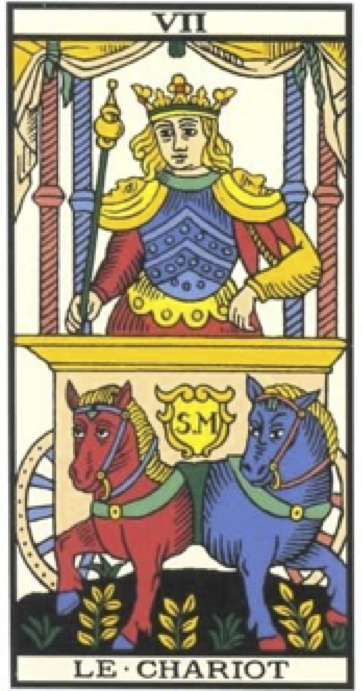
The scepter, terminating in spheres, symbols of cosmic matter, manifests the power which Man, once born, is in possession of on this material plane.

His golden crown has the same royal significance, but, while the scepter in his hand expresses the power of law, such power is represented by the scepter as mental and as unstable as the scepter is. This power is based on the aspects presented by the four elements of the same Cosmic matter, just as it is indicated by triangle made up of four small spheres which surmount the crown.

His blue, metallic cuirass states that humanity, in its ascendant and dangerous movement forward through the material world, must be thoroughly dressed in spirituality in order to protect itself.  It is white in the upper part, near the collar, and yellow in the lower section, because this spirituality must be directed by the intelligence which is of a divine nature and forms part of the cuirass.

The stages of this movement forward, as well as the interior states which accompany it, are indicated by the details engraved on the figure’s cuirass. In fact, we count fifteen points, divided into three series on the chevrons. The first two are composed of six points each, making a total of 12. This symbolizes evolution, and forms a polarization in which the upper and lower psychism (in other words, the spiritual and the passions) are in opposition to one another and in this way bring about each other’s evolution. The third series consists of three points representing what serves as bases for the psychism of the 12 points which are: the appetites, responding to the more base aspect of Man; feelings, responding to his central and intimate aspect; the desires, responding to his higher and mental aspect. The chevrons are separate from one another to indicate that the points of the lower psyche, marked on the lower chevron, will not exceed their placement in the psychic order of things, as these points represent the spiritual possibilities of an incarnate human being, possibilities which, limited by the psychic plane are not able to extend into the abstract. However, the lower chevron defines, by its position on the blue area, a plane which allows a physical body to penetrate the arcana of psychism. The upper chevron manifests another plane in which it is sufficiently elevated to go beyond the arcana of physical existence, enter the mental plane, and so permit the spirit to escape from the body. In sum, these two chevrons indicate the two spiritual planes possible for a psychic being.

            The four points appearing on the yellow lower border of the cuirass represent the four states born from spirituality on the psychic plane.

The cuirass consists of three parts to show that, in accordance with his evolution, Man is able to choose one part of the cuirass and abandon the other or put on all three parts and assume complete possession of the spiritual protection which it has to offer him.

Under this cuirass we see a red tunic, representing the material world which it is necessary for Man to cross in order to evolve.

His right sleeve, being red, signifies that he derives his active power from matter and his yellow sleeve that he assumes passive states of intelligence. The small red flaps coming out from under the mask on his left shoulder symbolize the material world which his yellow arm must rupture, stretched out by his intelligence.

            The two masks placed on his shoulders show that the visage of Man incarnate weighs on him and is nothing but a transient creation. And there are two of them: one which is created in the present and the other from the past which he retrieves, but neither is more important than the other. This is because they are small. They are red because they have been created by Man’s passions, and surrounded by yellow, since this is able to lend them strength by his own intelligence, and so fix for them a momentary life; in other words, each man loses a face which his intelligence is able to find or to recreate with great exactness, but this is of little importance over time.

This duality expressed by the two masks answers to the internal and external faces of Man, the first one by the left mask, his psychological aspect, the second by the right mask, his active side. Their horizontality, a mark of passivity, situates them in the intimate regions of Man; and the pieces of fabric indicate, in addition what was covered already, the fluid emanations of his psyche, fluids which penetrate the material world and so give the mask a fulcrum of support.

The figure’s yellow hair establishes the superior role of his own intelligence.

The chariot symbolizes the currents which lead Man along and oblige him to act without cessation. It also signifies that man is enclosed within his own passions by a stability entirely relative to himself, because it is driven along and carries him with it. The pillars, by their spacing, show that he is able to escape towards what is Above and that he remains in his chariot car only by virtue of the passivity which keeps him in the material world. Red in front and blue behind, these represent the equilibrium between the spiritual and the material worlds which advances the human race.

The flesh-colored canopy–the veil of our physical existence–as it is above him, it curtains off the sky, but it is light enough to be removed if one wishes.

The wheels of the chariot, flesh colored as they are, symbolize the cycles of life. The 12 studs visible on the wheel represent the 12 stages of evolution which Man must pass through in the course of his life, as well as the 12 forms of temptation which are able to assail him in the course of his evolution.

Spiritual activity, polarized in the material world, is represented by the red horse, and the blue horse symbolizes polarization in the spiritual world.

The ground, yellow, indicates that man only advances through his reliance on his understanding of the Divine, and the tufts of grass which are green are the image of the hopes which are born out of this with the progress of his advancement.

Orientation of the Figures

             The face of the figure is positioned so as to indicate that his action must be direct, and the heads of the two horses are turned to the left to indicate that intuition is necessary for progress.

Specific and Concrete Sense

             The name “THE CHARIOT” has been given to this card to indicate a tangible entity that, while advancing, symbolizes the idea of embarking and of progression. More generally, these are the material currents which lead Man and oblige him to be constantly in motion.

Meanings as they Relate to the Three Planes

            MENTAL. Realization, but with neither gestation nor inspiration. In other words, giving shape.

ANIMISTIC.  Display of affection, a female protector, beneficial, helpful.

PHYSICAL.  Great activity, rapidity in one’s actions. Good health, strength, hyperactivity.

As it relates to money, expenditure or gain, transfer of funds. It signifies also unexpected news, conquest. It can be interpreted equally as speech propaganda and, depending on where the card falls, good news or slanders.

INVERTED. A bad card, indicating disorder in everything through evil activities whose effects are difficult to gain control of.

*

In sum, in its fundamental sense, “LE CHARIOT” represents the perilous travels of Man in the material world as he strives for spirituality, through the exercise of his powers and the mastery of his own passions.

Back to Table of Contents

Does The Tower Symbolize a Tarot Deck? A House of Cards?

(I’m busily at work on my Marteau translation, but I want to wait until I have a sizable chunk before posting any more.  In the meantime, here’s something I posted last summer on the Tarot History Facebook page.)

Have you ever counted how many bricks high the Tower is in some of the Marseille permutations? In the Jean Noblet deck, for example, if you exclude the crown at the top, the tower is 22 bricks high. As in 22 trumps, I propose.)Image result for noblet maison dieu

But here’s the thing that’s really interesting: As you know, the sequential number of The Tower is typically XVI. Well, in the picture, the lightning severing the tower is striking it precisely at the 16th brick.

A coincidence? I then looked at the Tower of the (Conver) Marseille deck. Once again, we find that the tower is exactly 22 bricks high.

No photo description available.In this card, each level is made up of bricks until you get to the 16th level, which is depicted not as layer of bricks, but as a blank space.  I’ve always thought that was a really strange blank space, too. This makes the 16th level unique among all levels above and below it. Have a look at it in the third picture: it’s the level directly under the double windows.

I went on to look at several other Marseilles decks, and found that several artists made their Towers exactly 22 bricks high. (Though by no means all of them.)No photo description available.

I’ve just started looking, but I found at least one Visconti style Tower with a 22 brick-high tower.

An aside: I found out that the concept of the “house of cards” (and all that implies) dates back at least to the middle 1600s. And what else is the significance of The Tower except that it is a house of cards?


POSTSCRIPT:  After I had posted this, it was striking to me how some people responded by saying that, well, anything can be made out to mean anything, (which, if you have any academic training in art, you know better than) so so what? I think someone else countered that my observation had nothing to do with “divination purposes,” which is of course irrelevant to my observation; another person seemed to sneer at the idea of my having nothing better to do than count bricks. There were even more bizarre objections than that. I appreciate that this was only a Facebook page and not a forum of trained historians, but…well, golly.  


Card VIIII: The Hermit (L’Hermite)

3ca61aed1dc19884a7db933390251db0

Return to Table of Contents

 Draft of a Translation of Le Tarot de Marseille by Paul Marteau

Epitome

            It is represented by number 9 = 3 x 3, which is to say, 3 secondary ternaries included in a general ternary.  These ternaries respond to the cosmic planes, which can be translated by the terms “physical,” “spiritual,” and “mental,” or by the terms “life,” “love,” and “light.”

The secondary ternaries are reflections of each of the elements of the principle ternary; they are surrounded by them, but distinct. Thus love grasps life and light, and light is life and love. Without life, love does not manifest and, without light, it cannot be illuminated. Likewise, love exhibits a physical and mental quality; without the physical, the spirit could not be made concrete; without the mental, it would remain incoherent and lacking all restraint.

The set of this ternary, that is, the number 9, suggests the perfect coordination of all these elements.

General and Abstract Meaning

             This Card represents WISDOM REFRACTING ITSELF IN THE MATERIAL WORLD, wisdom in which truth is found, deeply hidden and concealed from human eyes. It is love and light and, when it enters into the material world, it proffers life.

Specific Analogues

            This Card follows “JUSTICE” as a search for the truth, indispensable for rendering justice.

The lantern, alternately yellow and red, which the Hermit holds in his right hand, indicates that this search must be carried out as much in the domain of light as in that of the spiritual. The top of the lantern, entirely yellow, shows that this search is guided by intelligence. It is in opposition to his cloak and partial covering, since it need not be illuminated harshly. As light can only be found in meditation of oneself, the cloak which envelops him is a symbol of this. It is blue, lined with yellow, because the spirituality must be internally intelligent. The one who seeks it without intelligence does not find it, but the yellow lining which can be seen on a corner of the cloak, to the left of the Hermit, is there to indicate that this intelligence is not so hidden that Man cannot see it, for he has need of it to evolve.

The red robe under the blue cloak shows that Man remains ever impregnated with matter and that it is in matter that he must find the truth. This interior garment represents, therefore, an inescapable material state with we are obliged to cover ourselves, while the cloak is the garment which which we submit to our will [?] according to our purpose and degree of evolution.

The red hood signifies that the truth appears to mingle intimately with matter, this being always in communication with intelligence, but the yellow ball at the tip of it shows that intelligence always dominates in the end, whatever the situation may be. On the other hand, this hood symbolizes momentary states of matter which we are able to cast aside quickly at will.

The staff, flesh colored, by touching the ground points to the correspondence which a Being is able to establish with the physical plane through its vital fluids. It signifies, too, that the way is difficult to climb and that Man often has need of some kind of assistance borrowed from the physical world.

The Hermit’s head and beard are flesh colored, since he is evolving through the receptive and active play of his fluids.

The yellow sun, striped with parallel lines, shows that he must always orient himself towards the same goal–that of initiation into the divine.

Orientation of the Figure

            He is standing in profile, with his head turned almost forward. He is oriented towards direct action in his thoughts, but action with consideration. He is disposed to proceed with calm, meditative steps, and his upright stance suggests a working environment.


Specific and Concrete Meaning

            The name “THE HERMIT” is given to this card to describe the retreat into oneself to examine the results of the actions which have been sanctioned by Justice.

Meanings as They Relate to the Three Planes

            MENTAL. A source of light to illuminate and resolve some problem.  An illumination which will appear spontaneously.

ANIMISTIC. A source of the solution. Coordination, reconciliation of affinities. This signifies prudence as well, not with the idea of fear but for the purpose of improvement.

PHYSICAL. A secret which will be unveiled, a light which will shed on hidden plans.

With respect to health: a source of knowledge about the state of one’s health with advice about the remedy.

INVERTED.  Obscurity, faulty understanding of a situation, the difficulty of going against the current.

*

            In sum, in its Elemental Sense, “THE HERMIT” represents Man in his search for truth, calmly and patiently, using logic and light, partly veiled, which he projects with prudence.

Return to Table of Contents