Card I: The Juggler (Le Bateleur)

LEBATALEUR

Draft of a translation of Paul Marteau’s Le Tarot de Marseille. A mighty rough draft at this point.

Return to Table of Contents

Epitome

            The number 1, an expression of universal positivity, symbolizes the primordial creative principle within its multiple realizations. The manifestation of this power, located at the origin of all things, causes it to engender by its repetition, all the active and passive universal forces which the other numbers are representations of. These are those which give individuality and identity to objects and phenomena of the observable world


General and Abstract Meaning

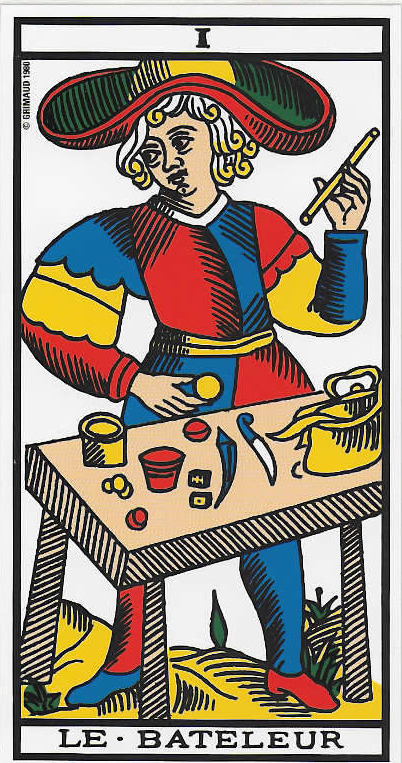
            In the study which follows, the first Card of the Tarot, as a reminder of the primary positivity, should provoke us to imagine an active and creative power. This is why it is depicted as someone who is standing, surrounded by certain attributes permitting him to perform his activities.

The symbolism of this first card expresses, therefore MAN AS AN ACTIVE AND CREATIVE POWER.

The qualities of this power are indicated by the layout of this card, as much in the details of the figure and his clothing as in the objects depicted.

At the Dawn of his manifestation, Man, cast forth on the Earth, surrounded by a world hostile by nature, found himself reduced to the activities of negotiation and defense. This instilled in him some reflexes which he strove to perfect. This skill he acquired throughout the ages, and still in the process of development, lends itself to a comparison in the Tarot between the human behing  and a juggler, obliged by his situation to direct his attention constantly towards the phenomena of the observable world. These tendencies, endowed with physical shape, give the first Card its name of Juggler.

First of all, you will observe that the Juggler is standing firm, his feet flat and firmly on the ground, connected with the magnetic influence which he continues to be subjected to. His wand (a symbol, like the sceptre, of intellectual authority) which he holds in his left hand and directs towards the sky permits him to maintain contact with the currents above, those which exert their influence on the earth. At the same time his right hand manipulates, with skill and discretion, the objects placed on the table. These are:

—The knife, bringing the Sword to mind, a symbol of effort, of difficulties, of struggles.

—The coins, representing the suite of Coins, symbols of acquisitions and jobs to be accomplished.

—The chalice, standing in for the Cup, a symbol of love, passions good or bad, and sacrifice.

—Finally, the wand which he holds in his hand, an image of the Baton, completing the four devices of the Tarot.


Specific Analogies

            In their generality one will remark first of all that his hat, whose exterior is bright green, signifies adaptation and mental force; its yellow or gold crown: wisdom; the red border: material passions. Its form as a [insert lemniscate here], a symbol of infinity, of universal Life, reminds us that Man is subject to the bonds of the universal harmonies in which he takes part.

The hair of the Juggler, white in their length and gold at their curly ends, designates intelligence as the fruit of age and experience.

His tunic above the belt is, on the left side blue and on the right red, and these colors are reversed below: the blue represents the psychic and receptive aspect of his personality, and the red, the passionate and active side of his personality, each in balance with the other.

His belt is yellow, a mental link united wisdom and spirituality, and his collar is white, for this spirituality must be subjected to intelligence, represented by his head.

His left arm is red on its upper part, yellow in the middle and blue on the lower part, and he is holding within his fingers a yellow wand; the arm is a a symbol of gesture and power, and the left arm is directed by the psyche, since the material world, inert in of itself, only moves under the power of the psychic gesture.

His right arm is the opposite of his left in its colors, and he is holding in his fingers a yellow ball which synthesizes the principle of cosmic matter. This arm is held lower to indicate that Man must subordinate his actions, as suggested by his right side, to the laws of the Cosmos when he maintains contact with them.

His legs, the left one blue with a red shoe and the right one red with a blue shoe, indicate that the right side dominates the elements through psychic and active equilibrium.

He holds a sphere in his right hand and, as depicted, looks like it could be a disk as much as it could be a ball. The Juggler is cultivating this illusion and is able to present it, as he pleases, as flat or spherical. The ball represents a state of continuity; when presenting it as as disk, the Juggler is limiting it and in this state it takes on the idea of human Intelligence. As a sphere, however, it is an expression of divine Intelligence. The Juggler can, using his powers, present it in one way or the other. In other words, he can confine intelligence to the physical plane and keep it there, and he cannot do so on the psychic plane. It is for this reason that he shows the ball in both its aspects.

The table, the color of flesh, symbolizes the fact that the machinations of the Juggler are supported by the living material world.

The sack of objects is yellow: scattered as they are, they have their own destiny, but will reunite in the sac, give up their individuality and re-establish unity by forming a complete composite, overseen by mentality.

The yellow vase represents mental power. It can contain the three yellow pieces, expressive of the trinity of element of mentality, and the four red pieces, divided into two sets of two to symbolize the double polarity which constitutes the four elements, the principle of the material world.

The separate use of the red pieces is a reflection of greediness, of the unique search for wealth, whereas the separate use of the yellow pieces denotes the struggle of the higher mental world. The simultaneous use of the three yellow pieces and the four red pieces creates a septenary  which gives off the raidiance and power of the divine intelligence allied to temporal intelligence.

The dice, a representation of chance, are yellow to show that the divine intelligence always intervenes and that nothing is really left to chance. The points marked on them certainly show that what Man calls chance is actually the combination of numbers obeying laws so profound as to be invisible.

The knife represents the object which can cut the thread of life, but the blue color of the handle indicates that it can only operate in a spiritual way, for Man is able to be master or slave of his destiny, depending on the state of his soul. Its sheath, also blue, underscores the freedom one has to use the knife or not. If Man puts the knife back in its sheath, he gives up the power of disabusing himself of defective sentiments and becomes a slave to himself.

The red chalice is the temporal power of combinations; the dice are, separate, like the knife separated from its sheath.

The ground, yellow, represents the energies which one must capture; the Juggler must rely on intelligence, and from this will emerge fertility, as symbolized by the green sprouts.

These diverse elements all invest him with the possibility of evolving the matter by means of the spirit, but, on the other hand, they oblige him to struggle against adverse hidden forces. If he relies on his wisdom, these forces will let him maintain his balance and he will so be able to be the master of them, instead of being their plaything.


Orientation of the Figure

            The upright posture of the Juggler, his body facing us, his head turned to the left[i], indicates that reflection must come before direct action. He weighs alternatives and makes a choice before acting.


Specific and Concrete Meaning

            The name of the card, “THE JUGGLER,” signifies the possibility of juggling many objects, that is to say, managing one’s circumstances with skill and making the right choices.


Meanings as They Relate to the Three Planes

            MENTAL.  A talent for combining things, the intelligent appropriation of the elements, of subjects which come to mind.

          ANIMISTIC. Psychic matter, that is to say, reaching out for new things, represented by the vigor of the figure and by his capacity as one who creates.

           PHYSICAL. The green on his hat is relevant, on the physical plane, to matters of health: great vitality and power over the afflictions of a mental or nervous nature, obsession or neurasthenia. This Card predicts a favorable trend, but is not specific and does not assure healing. To understand this, it will be necessary to consider the neighboring card. A tendency towards diversification in one’s actions, the lack of unity in one’s undertakings (indicated by the infinite diversity of possible combinations of the objects placed on the table). Hesitation. Indecision. Lack of certainty about events.

         INVERTED.  Discussions, arguments which may turn violent (considering the strength of the figure); imperfection in actions, misguided undertakings.


*


In sum, in its fundamental sense “THE JUGGLER” represents Man in the presence of Nature and with the power to master its currents.

[i] When considering the posture of each figure, the situation is determined by its relationship to the observer; for example, the head of the Juggler is regarded as turned to the left, while, in the world of the illustration, he would be looking to his right.
 

Return to Table of Contents

Card XV: The Devil

ladiablemarteau

Translated from Le Tarot De Marseille by Paul Marteau

Return to Table of Contents

Epitome

            Among the different combinations which constitute the number 15, the arrangement 10 + 5, and 11 + 15, is more suited for the context of Card XV.

Here we have Man introducing his particular vibration into an organized network; this activity takes place in opposition to the Universal Rhythm; hence, it is represented by the Devil.

10 signifies a completed cycle, and 5= 4 + 1 indicates beginning a cycle again, an activity which penetrates the material world, one which rises up to struggle with it and invest in it, through vibration,  represented by 5, the rhythm of life. Another way of looking at it is that 10 presents the equilibrium of a completed cycle and 5 marks the instability of a new beginning with all its uncertainties.

11 indicates force and 4 is matter, so 11 + 4 = 15 signifies the strength of Will vigorously stirring up matter, Will which used for good as well as for evil. This combination confirms and accentuates the preceding one obtained by 10 + 5, and this is why this Card follows Temperance which it has the effect of materializing. The eternal recurrence of Temperance takes place on the moral plane; the Devil takes it into the human plane.

General and Abstract Meaning

             THE DEVIL IS A PRINCIPLE OF SPIRITUAL ACTIVITY WHICH SEEKS TO PENETRATE MATTER AND DRESS ITSELF IN IT IN ORDER TO MATERIALIZE ITSELF.  It symbolizes great evolution because it is the symbol of evil; it is also a symbol of triumph. There are those who have given it a maleficent symbolic value, but it has profundity and is of a divine essence. It is also as necessary for humanity as good is, since it is a bridge between good and evil. Divinity, as Man conceives it, can be imagined according to his interpretation as Good and Evil.

Specific Analogies

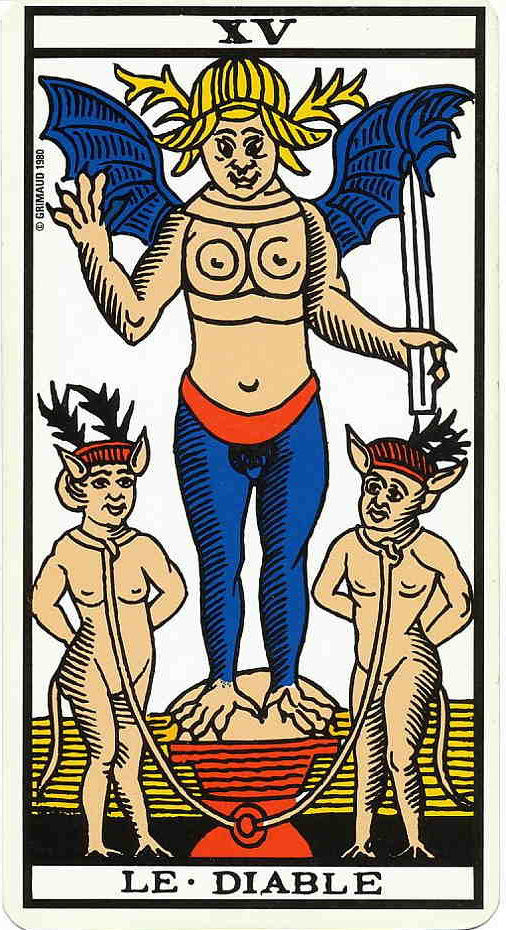
            His headdress is a wreath of flames to show that his origin was born on a higher plane, since if the Devil expresses in the real world the struggle of Man in the universe without the support of the Divine, he is no less himself an expression of divine laws.

His blue wings, upright as they are, show that his action tends to produce an upward evolution.

His torch illuminates the world of illusion; its white flame indicates his neutrality, and people, depending on the the activities which they attribute to him in his domain, are the only ones who can lend it color.

His fleshy torso, having both nipples and breasts, represents both the male and female fertility of the vital forces in the material world. His right arm is raised to affirm that his action is coming from Above, but his fleshy claws and his placement on a flesh-colored surface make it clear that he is clinging to matter and that he will never be able to operate in the Divine plane.

His red belt denotes that he is entirely encircled by matter, all the way down to its most base expressions. His blue legs show that he is causing Man to evolve towards spirituality.

His hermaphroditism, marked by the simultaneous depiction of attributes of both sexes, demonstrates (depending on whether one looks at it from a universal or a particular point of view) that he is perpetually engendering, all by himself, the renewal of matter either by penetrating it with his vital strengths, or by drawing it back into himself because, by encompassing both the male and female poles within himself, he functions in a self-contained system and controls the vital forces for himself.

His red pedestal indicates that he dominates the material world. It is of a modest size to show that his rule is precarious and made unstable through his nefarious activities.

The two beings bound to the pedestal are the emanations of the Devil and represent the exterior aspect of his sexual polarity, showing that one is in bondage and that the other will feel the his tugging on the chain, without being able to escape. On the other hand, they also symbolize  the domination which subjects to slavery all human and animal matter–that is to say, the entire world.  They are male and female because by extension they are the two principles of polarity of the whole world. They wear on their heads red headbands to show that Man can be mentally entrapped in the material world, as the Devil by himself not offering any principle of elevation. The black flames, the ears, and the animal tails indicate that the Devil is a force necessary for evolution, from which one must free oneself and which, without this effort, Man remains trapped in the material world, whose only emanations will be dark ones. In other words, the Devil symbolizes Man in bondage to Nature, which renders him part animal.

This bondage is based on the laws of cause and effect, which is to say in the repercussions produced by Man’s past actions. These effects are evil when Man permits himself to be chained to the material world, but become forces of evolution when he struggles to free himself.

The ground, striped with black lines on a yellow foundation, signifies that the emanations of the material world stemming from evil are able to conceal the sources of divine intelligence. The parallelism of the lines indicates that the two proceed together.

Orientation of the Figures

            The main figure is face-forward, suggesting a direct act of domination, but by contrast the smaller figures are a quarter turned: the one on the left (the female) towards the right, and the one on the right (the masculine) towards the left, with their heads almost face-forward, hence in opposite directions, suggesting thereby the force of passivity combined with that of activity–but with constraint and disharmony as designated by their attachments, their horns, and other animal features.

Specific and Concrete Meaning

             The name “THE DEVIL” has been given to this card because it represents Man acting in the material world through his own power, without spiritual support, so that when he is not in search of spirituality, he is subject to the temptation of transgressing against cosmic morality and capitulating to his instincts. The Card signifies, therefore, success in the material world through direct effort and through the council of reason, or surrender to the inevitable.

Meanings as They Relate to the Three Planes

            MENTAL. Great egotistical activity without concern for justice, this Card not having any practical significance in the spiritual world.

ANIMISTIC. Plurality, diversity, inconstancy, because we are searching in all directions and relating everything back to ourselves, without concern for others.  Debauchery.

PHYSICAL.   Great influence in this plane, especially in the material domain, in concrete implementation. A strong force of hold on others. This is, however, a card flawed in the physical world; when it signifies victory, it is victory obtained by evil means. Thus it is a benefit acquired in a reprehensible way, or through thefts committed with impunity. In the realm of emotions, it is the conquest of another physical being through deplorable practices, without scruples, leading to the destruction of others, but having a successful result. This is because it is a card heralding punishment; when it appears in a spread, it announces a the victory which will be but momentary, and followed by retribution, if the question posed is not free of egotism.

Like a disease, it indicates a great nervous instability, symbolized by the claws drawing on mysterious powers and asserting control and possession, the results of humanity’s past. 

            INVERTED. Activity based on something evil, with more malevolent results. Disorder, inversion, business questionable or lacking results.

With respect to health: increase of trouble, complications.

*

            In sum, in its fundamental sense “THE DEVIL” represents a form of human activity, the stirring up of the material world, in which Man will become enslaved after he has obtained an ephemeral success, or freeing himself with the powers of consciousness, depending on his egotistical goals or material evolution.

Return to Table of Contents


Card VI: The Lover (L’Amoureux)

Translated from Le Tarot De Marseille by Paul Marteau

(Return to Table of Contents)


Epitome

The number 6 can be written like this (1 +2) + (1 + 2) to put it in conformity with the placement of the figures on this card. The number 2 by nature represents a fertile passivity and the feminine principal. the two women thus constitute 2 + 2, while the masculine figure and the archer constitute two units, one in the lower part and the other in the upper part. (1 + 2) + (1 + 2) represents the double current, both involuntary and evolving, emerges from matter or leads to it.

            The collection of elements of this card establish a fusion between the spiritual and the material, because the two women are meeting in the figure as an emanation of their material desires, while the archer represents the spark. 

General and Abstract Meaning

            This card indicates  THE FEELING OF PHYSICAL LOVE FOSTERING SPIRITUAL LOVE, and it signifies that love is pivotal for the evolution of beings and for the creation of things. When love arises, the soul is exalted, the spirit projects a spark toward The High, which immediately starts to operate on a higher plane. This is symbolized by the archer, a representation of love stretching his bow in the HIGH part of the card.

            The shock produced by this spark will bear its fruits and leave a trace represented by the arrow, which is to say, that love, by elevating Man above himself grants him in the physical plane some realizations coming out of from his own genius. A musician, for example finds in it his inspiration. Love is never sterile.

Specific Analogies

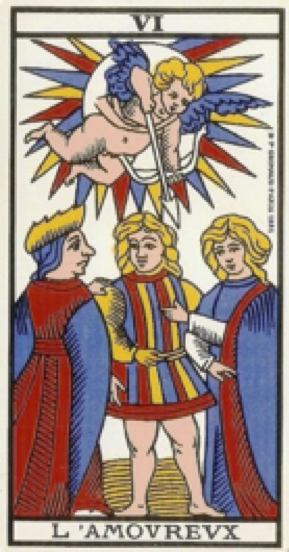
            The symbolic interpretation of the details of this card highlight that the rays which emanate from the archer alternate in red, yellow, and blue, since the radiance of love operates on all planes. The figure is flesh colored to show his action in the vital fluids. His sash is a bond and a mask: the bond between our disposition to connect love to the earth as well as to mask it with an earthly sensation, while still being of divine essence and so unable to take root in matter. It is placed on him obliquely, and not around his waist. This shows that he is not able in any way to be taken prisoner.

            His blue wings show that the first idea of love is a flight towards mysticism, and his yellow hair shows that the intelligence of love elevates Man above material things.

            The bow and arrow indicate speed and rhythm, for the arrow is a dynamic principle. They are white, therefore negative, since the action which love tends towards is profoundly internal and more virtual than real.

            The woman placed to the man’s right represents Profane Love, love born from material well-being; her left hand, which she is placing on the man’s shoulder and her right hand around the middle of his body signifies that she is influenced by sexual polarity, however transitory, since the wreath  which she has on her head is removable and indicates that her power is ephemeral. Her long blue sleeves, hanging down but open, indicate a tendency towards spirituality, but her blue hair indicates superficiality. The sentimental effect provoked by the appeal of material satisfactions cannot last because it merely a mirage on the physical plane.

            The woman placed to his left represents spiritual love and love between the sexes in their most noble state. Her hair, long and blonde, indicates a solar role and the inspiration which results from this love. Her left hand placed on the man’s chest shows that this superior love has the heart as its source. Her right hand directed downward and indicating the gorund  signifies that she is causing the material world to evolve. Her blue cloak affirms her spiritual role and her blue robe bordered with red shows that she is adapting the sexual movements towards spirituality. Her white arms underscore the exaltation which she is expressing on all levels by the harmonious synthesis which she is engendering in a full range of feelings.

            The man personifies someone who is in a state of evolution in the whole Cosmos, which is to say, everything that is subject to love’s law of attraction. We symbolize this with a man, one representing the most elevated level on the scale leading to the highest spirituality. His tunic with its red border shows the instinctive. side of love, the blue, yellow and red stripes illustrated the various vibrations of love which spread through the different planes. The yellow of his arms and his hand show the active tendency, activated by intelligence towards the Divine Love. His right hand is under his belt, signifying that it is by a voluntary action that he has clearly separated spiritual love from visceral love. His hair, yellow, shows that intelligence must dominate and direct him on the physical plane. They are yellow, like the wreath on the woman to the right, they differ from it in the sense that they represent an intelligence which is an integral part of the man, and not just something temporary.

Orientation of the Figures

            The archer, a quarter turned towards the right, expresses the evolutionary factor directing Man, in whatever he does, towards his constant transformation, his evolution never ceasing. The wreathed woman whose profile is equally towards the right, is aiming for continuous action; the one whose head is turned to the left, but looking forward, is an invitation to the interior life prior to direct action. The man, facing us, with his head a little to the left, is making a choice after reflecting; and the whole arrangement represents, with respect to action, a very complicated card.

Specific and Concrete Meaning

            The presence of sexual polarity in the Human Being in all activity which he is prevailed upon to perform, his behavior in the discernment which is required to perform to direct his LIFE, is what gives this Card the title “THE LOVER” [L’AMOUREUX].

Meanings as They Relate to the Three Planes

            MENTAL. Love of beautiful forms in the plastic arts.

            ANIMISTIC. Devotion and sacrifices.

            PHYSICAL. Desires, love, sacrifice for one’s country, as well as all strong feelings in the physical plane. A card of union, marriage. It represents, for the consultant of either gender, infidelity or, in certain cases, a choice to make.

            INVERTED. Disorder, schism (as opposed to uniting), rupture, divorce.

*

            In sum: in its fundamental sense “THE LOVER” represents the goading of deisre, which incites Man to join with the Universal, whether harmoniously or in a state of imbalance, according to whether he sacrifices himself for it or he wants to derive some profit from it.

(Return to Table of Contents)


Card XIII: Death

Translated from Le Tarot De Marseille by Paul Marteau

Back to Table of Contents

d

Epitome

The number 13 equals 12 + 1. It symbolizes the commencement of a new phase in the fundamental evolution signified by the Tarot.

This card is connected with The Hanged Man to take into account of the knowledge acquired by the preceding cycle, which must be pruned of things useless or detrimental, and unsuitable for the nature of the new cycle; and also because the spirit of sacrifice, suggested by the Hanged Man, leads to the light whose doors open with the disappearance of the physical body. It is the activity that does take place during a state of things frozen in place.

General and Abstract Meaning


This card indicates TRANSFORMATION; IT SYMBOLIZES MOVEMENT, THE PASSAGE FROM ONE LIFE PLAN TO ANOTHER LIFE PLAN. It is, in the realm of the visible, the opposite of its appearance to our world; it represents, in effect, immobility in this physical life, and that of moving forward in The Beyond.

Specific Analogies


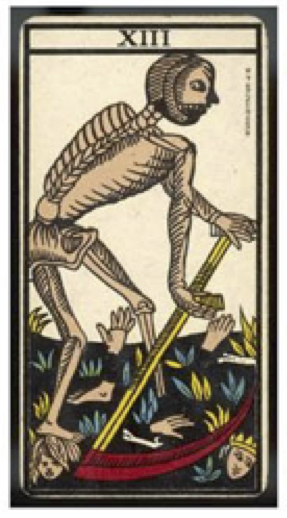
The flesh color of the skeleton indicates the persistence of human individuality, thus expressing the fact that is doesn’t have to do with physical death, and that there remains in the Being another life form.

The loss of all its terrestrial attributes is characterized by the fact that it has been denuded of clothes and flesh, keeping nothing save for the armature necessary to bear a new covering. The principle of life which its color symbolizes shows the transformation which it is bringing about, and without which Man would be frozen in place, and so experience a true death.

It is reaping in a black space, symbolizing the dark passions of people as well as the path of the next process of evolution, which is for us still obscured. His hands and feet have not been cut off, but represent principles of action and of progress. They signify that death delivers Man from his physical life, leaving him with the power of gesture and of going forward. In fact, going forward, as indicated by the placement of the feet on the plane, shows that Man progresses from one incarnation to another; gesticulation, indicated by the land, symbolizes tact and sensitivity; placed on the ground, this is what he does in his incarnate state. Hid feet are on the black part to indicate that despite death, Man remains connected to the earth, and that he is supported both on the earth and within the earth so that he may be reborn. The two hands which are above the black part show that death spurs Man on to disengage himself from the material and to raise his gestures toward That Above. The two bones, being white, represent the emptiness of materiality; there are two of them and thus represent the polarities of masculine and feminine. The head of the child with long hair makes it clear that strength and intelligence do survive death, but the Divine Intelligence has always been present in Man since his infancy. The head with a crown signifies that each time death occurs, Man enters into his kingdom. The head is that of an adult, the royalty of Man being an immutable thing which has neither childhood or agèdness.

The yellow and blue leaves symbolize fertility; death does not cut them down, and they sprout every time Man goes down the passage of death. This fertility comes as much from the knowledge acquired on the physical plane as the forces of evolution appertain to the spiritual plane.

The handle of the scythe is yellow, because death comes from a Divine Will and Intelligence, and the scythe is red because death is always slicing into matter; moreover, this scythe in this card is not the representation of a cutting instrument, but the symbol of an activity which stirs up matter in order to renew it and bring it into being.

The figure has but one foot to show that death implies a disequilibrium and can operate only on the physical plane and not in the spirit. It is not a harmonious thing, but a consequence.

Orientation of the Figure

            Its profile, entirely facing to the right, shows transition, renewal, successive actions, owing to the suggestion of going forward; a transformation with every step.

Specific and Concrete Meaning

             Contrary to the other cards, this one does not have a name, its image being a classic representation of death. It does not exist cannot be named because that would endow it with a pejorative force, one which it does not have. Its true sense is that of transmutation, but even this isn’t exactly the right word, because transmutation is at the very origin of life, and this origin is ineffable.

Meanings as They Relate to the Three Planes

            MENTAL.  Renovation of ideas, completely or in part, because one thing is going to intervene and change everything, like a catalystic phenomenon, where a new body modifies completely the action of the present bodies.

ANIMISTIC. Estrangement, dispersion—of affection, or of the attachment to a sentiment, or of a hope.

PHYSICAL. Death, the cessation of something, immobility. In the matter of business, complete transformation.

INVERTED.  Stagnation from the point of view of health; death can be avoided, but the illness is incurable. According to its surroundings, it signifies death whose effects persist beyond itself in bad actions.

*

In sum: in its elementary sense, Card XIII represents the changes of states of conscience in Man which accompany the end of a cycle completed and at the beginning of a cycle of a different nature.

 Back to Table of Contents

Orientation of Figures and Symbolism of Body Parts[1]

Translated from Le Tarot De Marseille by Paul Marteau

((Back to Table of Contents)

The orientation of the figures indicates the nature of the action, according to whether the figure is seen in profile on the left, straight on, in profile on the right, or there is mediation, responsive action, direct action, or evolution (that is to say, training action). If the figure is standing, it is an indication of some hidden travail: activity, giving orders, energy.  A seated figure’s action is executed in a passive mode: inertia, resistance or internal planning.
In this interpretation, the head plays the capital role, because it gives indication of tendency or will; if, for example, the body is presented standing in a frontal view, but the head is turned to the left, as we see in the Juggler, this indicates some sort of reflection preceding a direction action which is being prepared.
The HEAD in the Tarot express the will, the act of commanding.
The COVERED HEAD corresponds to figures who are not expressing their will with their bodies, because the headdress, being a material thing, the will is expressed in an set of ideas symbolized by it. For example, a crown represents a very powerful outward expression, but one originating in more subtle planning, owing to the jewels which draw our attention. The will is more impersonal in the other head coverings which represent things engendered by the personal will.
The HAIR expresses a flowing of effusion. If it lacks color, a strong force of will is not present, but if it is colored, this is a greater manifestation of mental activity. If it is the color of gold, it represents a mental realization more formed, more concrete, more realized; if blue, the force is more located in the spiritual and tends to stay there.
HAIR IN DISORDER is an indication of a will with great power behind it.
HAIR CAREFULLY STYLED has no one particular meaning. The expression of will may be more contained–for example, JUSTICE, which is closely directed state of mind.
A BEARD indicates the will, a willful and more focused concentration.
The NECK is a passage between the mental (the head) and the spirit (the chest).


COVERED, it indicates a simple communication between the two planes; COVERED, it re-enforces, according to its color, the difference between the mental and spiritual intensities.
The NECK needs to have a high neckline if it is to avoid excessive letting go and losing composure.
Completely uncovered, it represents freedom, independence.
The TORSO represents the spirit; buttons and ornamentation are spiritual enrichments, specific aspects. if the clothing is of two colors, the spiritual has a double meaning.
The whole torso represents the spirit, with its spiritual side represented by the breast, and the material side by the stomach–for example, instincts and maternal love.
The BELT is the reasonable aspect of the psyche: a being does not give in and impose reasoning on his dispositions.
The ARMS specify thoughtful, reasoned actions. They are the interpreters of the mind and of the mind (their color indicates whether the mind is prevailing over the spirit.
The LEFT ARM is the conveyance of a spiritual message which is altruistic and emotional; psychic power directs it.
The RIGHT ARM conveys decisions, volitions, hopes, the realization of action.
The LOWERED ARM signifies an action which has born fruit or an impediment to action: the arm directed downward of the Juggler underlines his indecision and submission.
The RAISED ARM indicates a connection with the High, the seizing of forces.
ARMS ON THE BELT at the midriff represent a circulation between the spiritual and the physical, as if untying or letting go, or making a decision about something.
The LEGS indicate the realization of something through action. If the entity is standing firm, the action is firmly based; crossed legs represent waiting or the status quo.


Continue reading “Orientation of Figures and Symbolism of Body Parts[1]”

Introduction by Paul Marteau

Translated from Le Tarot De Marseille by Paul Marteau

(Back to Table of Contents)

     The Tarot is a collection of figures who symbolically express the struggle of Man to realize his evolution, that is to say, to arrive at the prescribed purpose of his destiny, an evolution which requires of him struggles, effort, joy, and suffering, depending on whether he accepts or does not accept universal laws.

Having chosen the Tarot deck which best expresses this destiny, the Tarot de Marseille,[1] you will find in this volume a symbolic interpretation of it.

*

The 78 cards of this Tarot are presented in two different parts. First, the 21 cards ( + 1) traditionally called the Major Arcana, and then the 56 minor cards arranged in four series of 10 cards each, according to the four suites.


*

To arrive at a symbolic interpretation of this Tarot, you will note that each Major Arcanum[2], save the Fool, bears a number located on the upper part of every card, all of which also have pictures of people, animals, and objects in the middle part, and a name at the bottom, except for card XIII.

*

          The 10 Minor cards–of Swords, Cups, and Batons–with the exception of the Aces, all bear numbers, but no names. The 10 cards of the suit of Coins have neither number nor name, while the 16 court cards that follow have no number, but generic names.


*

The number, understood symbolically, revels the philosophical principles which allow us to understand the articulation of the construction of the Cosmos with all its laws and principles.

The meanings which each number is able to provide are infinite; the comparison of the principle represented by the number with the figure makes it possible to speciy the point of view from which each one has been envisaged et, on the other hand, also provides the bases of interpretation with the nature of its colors, the relative arrangement of the objects depicted, and the particular meaning which presides over the illustration on the card.

*

The colors of the clothing of the figures which can sometimes seem incoherent, or the naive way in which some of the figures of this Tarot have been drawn are not, as certain commentators have apparently supposed, mistakes or oversights, but they contain a very precise symbolic value which I shall endeavor to reveal.

*

Finally, the nomenclature, because of its exact characterization, symbolizes the concrete and tangible aspect that each card can express, whereas the number endows it with its Principle. The study of this nomenclature will make it possible to be precise about the material meaning of each card.

*


We shall study, therefore, each Major card in the following order:

—The analogic meaning of the particular number specified by the card or Principle;

—The abstract[3]meaning extrapolated, which gives us the general character of the card;

—The development of the details through the interpretation of the attributes, colors, and particulars of the card;

—The orientation of the figure;

—The significance of the name used for the card, the relevance of this meaning to its concrete aspect—this significance being subordinate to its abstract meaning;

As the positive significations which can be derived are too numerous to consider all of them, we shall limit ourselves to offering a few meanings in each element of the Human Ternary: that is, the MENTAL, or intelligence; the SPIRITUAL, in other words, emotive feelings, and finally, the PHYSICAL, the utilitarian aspect of life.

Then, as each thing also presents its opposite, we shall express the significance of the card when it is inverted.[4]

We shall then conclude with the description of the Basic Meaning of the card.


*

The circumstances under which the Major cards have been studied, modified by the Minors, a new study of the symbolism of the numbers on the one hand, and of the names on the other, will be reviewed before their interpretation.

*


The Tarot is a universal vibrating instrument and becomes a source of energy for the flowing projection of our thoughts.

By giving us the symbolic keys of the universal laws that preside over the destiny of Man, the Tarot allows us to make present associations and, consequently, to predict certain events through analogy or affinity.

To make it possible to take advantage of the cards in this conception, we will finally present the method of using card combinations to deduce form them the events which will result from any concerns one has when laying out the cards, as well as the elementary rules by which it is possible to derive useful meanings.[5]


PAUL MARTEAU, Paris, 1928 – 1948

Back to Table of Contents

[1] This Tarot is that which was edited in 1761 by Nicolas Conver, a master cartier in Marseille, who had conserved the wooden stamps and the colors of his distant predecessers. This Tarot is now edited by B. P. Grimaud, who acquired the estate of Conver, and was also able to continue printing the traditional Tarot in its original form.

[2] [Translator’s note: it is my thought that, when speaking of a single card, the correct word would be “Arcanum” in accordance with the rules of inflection governing a Latin 2nd-declension neuter noun. Marteau’s French simply reads Arcane majeur.]

[3] The general meaning or of the principle which we shall call abstract, as opposed to its material or utilitarian meaning, which we shall call concrete.

[4] [Translator’s note: Marteau actually says renversée, reversed, but by this he means inverted. One reads the card upside-down, not the back of the card.]

[5] The reader will kindly excuse the repetitions and the slightly ponderous phraseology. It is difficult to translate the abstract into the concrete while remaining faithful to the interpretation of the subjective idea. The various words available for this are insufficient in number and are overused. You might want to regard this book as a kind of dictionary or even an encyclopedia where explanatory details about each card may be found.

Le Mat (The Fool)

Translated from Le Tarot De Marseille by Paul Marteau

Back to Table of Contents

Draft of a translation of a chapter from Paul Marteau’s Le Tarot de Marseilles, 

by Kitos Digiovanni

grimaudtdm00amat

Epitome

     This card is not specified by any number, for it would be necessary to assign to it either 0 or 22. The Fool cannot be 0 without representing the indefinite universal, since he is mobile and symbolizes a process of evolution. Nor can he, on the other hand, be listed as 22, which is to say by two passivates which imply inaction—something which is absolutely contrary to the appearance of the figure represented on the card.

[Footnote: However, if put in the sequence, this card ought to be regarded as the number XXII.]

General and Abstract Meaning

     This card represents THE INEXORABLE MOVEMENT OF A PERSON TOWARDS EVOLUTION.

Man, not yet having realized all the injunctions of Card XX, and, consequently, not yet having reached the apogee of his evolution, must nevertheless pass through successive lives as a vagabond, one with no thought of tomorrow and without knowledge of his or her destiny, since it is the experience of the improving quality of life which drives one go down the long road of incarnation.

This card is normally placed at the end of the deck. But if required to fit in, it would find a place after the other multiples of 7–that is to say, after the Chariot (1 x 7) and Temperance (2 x 7). This is in view of its evolutionary character.

Although found at the end of the deck, it is not a pessimistic conclusion to it, since it does not represent a person who, having seen the book of all human possibilities, everything that directed him, and every necessary path, must carry the weight of these experiences and end up discouraged.

On the contrary, it shows Man who returns with each birth, without the memory of what he had been and no knowledge of what is to come. It is this insouciance which allows him to go through the steps leading him to perfection. This card forms a conclusion for the preceding 21 cards, but it is not the conclusion of his destiny. When a person has reached his apogee, his destiny will be resolved and its conclusion will be be attained with card XXI.

The Fool also represents a liaison between the Major and Minor Arcana, the latter offering an interpretation of the person with respect to his actions.

Specific Analogies

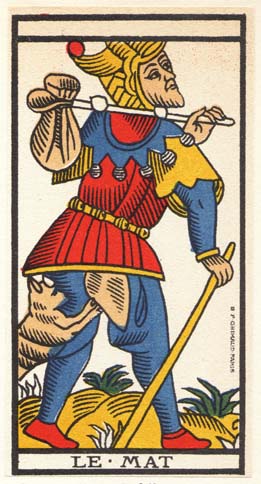
    The stick on which he carries his bindle has rings fixed on it which prevent it from sliding down and falling on him. This signifies that the man is not able to settle down anywhere on the path which he is following. The bindle is the color of flesh to indicate that Man must always carry with him the history of his descent in the physical plane, since all that which has contact with the physical is a descent. On the other hand, it is also his experience, a kind of Pandora’s Box which he cannot open and on which he relies. It contains his illusions and his past. The stick is white—in other words, neutral—to show that this is not a burden he himself has created.

The yellow stick in his right hand, resting on the ground, puts him in contact with the physical world and shows that by his intelligence he draws strength from the same roots whose birth on earth he brought about.

The patch of exposed flesh at which the dog nips is the lowest part of him, the part of him that remains Animal. It is visible because, despite the clothing which he has created in the course of his evolution, it cannot be detached from him. The dog also represents the errors of the past which persist in troubling a person as he goes forward. This dog also symbolizes an inferior life plan which has a way of springing up and chasing after him. Just as the man has risen above the plane of animal existence, he must not forget that while he marches forward towards his evolution, his fall has brought him back to the level of the animal, and that on his journey he must bring about the evolution of inferior creatures surrounding him.

His yellow cap, ending in a red tassel, signifies the intelligence Man must cover himself with in order to follow the path through the material world. The red point indicates a material, and not a divine, intelligence.

His blue collar with the points ending in bells shows that the man on his journey is disoriented by the rumors of his past incarnations, and the noise which it creates for him on the ground prevents him from finding his divine memories and the strength to march forward. There are also bells attached to his belt, as there are to his blue collar, to indicate that he is as disoriented in the material world as he is in the spiritual one.

Coming out of the yellow sleeves are blue arms which mean that the person, has intelligent thoughts (the yellow cap) and thus the capacity for intelligent deeds, but they will only have efficacy if he knows how to ground them in spirituality.

Although Man travels in the material world in his successive incarnations, he only advances through spirituality, as indicated by his blue trousers and red slippers.

If Man proceeds like a vagabond through his lives, his march is nevertheless an intelligent one, not because of him, but because the path is being directed by the divine Intelligence, as represented by the yellow ground. The ground is rough to indicate the difficulties in his life. The tufts of grass signify active fertility; some are green to symbolize the act of fertilizing on the physical plane as relates to the vagabond’s passage through incarnation. Others are white and symbolize the fertilization which he is bringing about on the abstract plain during his disembodiment. They are, consequently, invisible on the physical plain.

Orientation of the Figure

     The Fool marches from the left to the right, but his head is turned around three-quarters, suggesting that he is studying his actions, reflecting before acting, and bringing about his evolution.

Specific and Concrete Meaning

     The denomination Le Mat which has been given to him has the meaning of mat in chess [échec de mat is French for “checkmate”]–in other words, confined. He is in effect afflicted with a burden he cannot put down, driven on by a dog, stimulated by the sound of his bells, besieged by his worries on the road, the obligation to go forward and the imposition of situations which he will encounter on his journey. He is, therefore, insouciant in the sense that he does not have an awareness of the obstacles of life and will not subsequently see them.

Meanings as They Relate to the Three Plains

     MENTAL. Indetermination due to the multiplicity of troubles which will present themselves and of which he only has partial awareness. Ideas in the process of changing. Uncertain plans.

SPIRITUAL. Feelings in transition, uncertainty in undertakings, base, indefinite sentiments.

PHYSICAL. Lack of awareness, lack of organization, insouciance about keeping promises, insecurity, departure or displacement. Willful forsaking of material goods. Slow business.

With respect to health: lymphatism/bloating, swelling, abscess.

INVERTED. The Fool, being a figure on the move, indicates that he has either fallen or has been halted in his movement. Forced to forsake material goods and a descent without the possibility of return or hope. Complications, messes, incoherence.

** ** ** **

In sum, in its elementary sense, LE MAT represents Man proceeding on his course of evolution with insouciance and without stopping, bearing the weight of the goods and evils he has acquired, stimulated by the ringing of his thoughts, his worries of the moment or his baser instincts, until the moment when he will have a realization of the equilibrium indicated by The World card.

Back to Table of Contents

Continue reading “Le Mat (The Fool)”

Identification of Mysterious Object on the Viéville Hermit Card

Kitos’ Solution to the Mystery of the Floppy Staff…maybe

I have written about this subject elsewhere and submitted my theory for public exposé, but I might as well start things off by presenting it to you here.

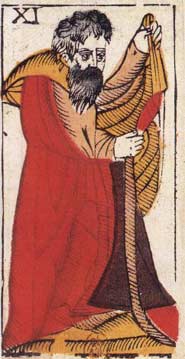
To me, the 17th-century Viéville deck is one of the strangest historical French decks in existence, since sometimes you can’t even tell what objects are being depicted, or what the scene is supposed to be. Look at that thing the Hermit is holding.

37795877_10155640203446334_4012375657857155072_n.jpg

Should be a staff, right? But it looks kind of floppy. Is it a snake? A snake staff? A stiff snake? But it also looks like it has a flame on top. The only book-length study of the Viéville deck is Patrick Coq‘s magnificent two-volume work, the first of which is devoted to the Majors: Les Mystères de Viéville, 1ère partie: les 22 arcanes majeurs.  He suggests a certain fluidity in objects. They might simultaneously depict more than one thing. In this case, a snake and a staff, à la Moses’ staff.

         I at least want to augment what Patrick says, so here’s my theory.  If I’m right, it would require that the artist be one cunning person. I’m not adamant about what I think it is, either. This is just a proposition.

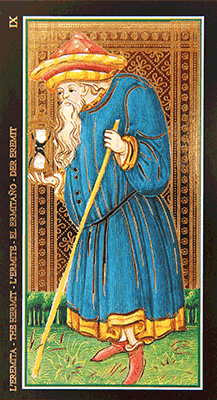
First, some background: the standard accoutrements of the Hermit are things like a lantern, a staff, and an hourglass, right?

Arcane-Arcana-09-hermite-hermit.png
Image result for hermit tarot conver

      In other words, things associated with light, with movement, and with time.

Okay, what if there existed an object in 17th/18th century France which was associated with all three of those things, but which also looked like a snake with a flaming head?

There is such an object.

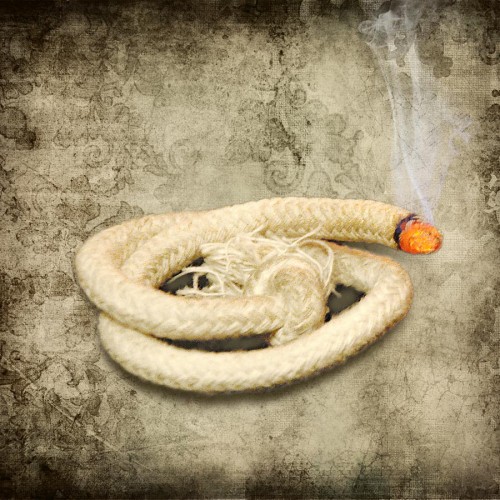
I am about 85% sure what the Hermit is holding is match cord, also known as slow match.

That is to say, it is a very slow-burning rope. This was a common thing in 17th-century Europe.

doutnak1-500x500

Essentially it’s a hempen rope which has been soaked in a certain solution and allowed to dry. Then, if you light the end of it, it will slowly smolder, perhaps so many inches
per hour, and then you can carry it around without worrying about it going out.

Forts fitted out with canons would have a length of match cord stretched out behind them. When it was time to fire, you’d just pick up the match cord and touch it to the fuse or touchhole on the cannon and boom.


So there’s your association with movement, the staff.

You can blow on the end to make it really light up. There’s your Hermit’s light.

You would even put a short metal sleeve on the end of your slow match  which is exactly what the Hermit is doing in this card. So that explains that detail exactly.

But—and this is the thing—with some rough idea of how long your matchcord took to burn, people used it as as a timer.

And there’s your Hermit’s hourglass.

The artist of the Viéville deck came up with a way to combine the three separate symbols, the lantern, the hourglass, and the staff. into one. If I am correct, that is one efficient image.

At the same time, it has the shape of both a snake and, hanging like this, a staff.

What do you think? I’m burning to know if this sounds plausible, or if you think it’s some other thing.